
How to Choose a Steel Structure Laser Cutting Machine: A Complete Guide to H-Beams, Profiles, and Tubes
2026-10-22


Steel structure fabrication involves more than cutting steel to a specified length. Manufacturers also need to process H-beams, I-beams, channel steel, angle steel, plates, and tubes, and complete additional operations such as hole cutting, beveling, notching, and marking.
Traditional steel fabrication workshops often use band saws, drilling machines, beveling machines, and plasma or oxy-fuel cutting equipment for these tasks. Although each machine serves a specific purpose, repeatedly transferring workpieces between machines can increase material-handling time, labor requirements, and production-management complexity.
An all-in-one steel structure laser cutting machine offers an alternative by integrating multiple compatible processing operations into one system.
So how do you choose the right machine for your factory? Can a tube laser cutting machine process large H-beams? How should you select laser power and processing range? And is an integrated machine a better investment than several separate machines?
This guide answers these questions and introduces the AORE GR-H Series all-in-one laser cutting machine for structural steel processing.
1. What Is a Steel Structure Laser Cutting Machine?
A steel structure laser cutting machine is industrial equipment designed to process structural steel components used in construction, industrial buildings, bridges, and other steel fabrication applications.
Depending on the machine configuration, it can process different types of workpieces:
H-beams and I-beams: Commonly used in load-bearing structures, industrial buildings, and support frames.
Channel steel and angle steel: Commonly used in frames, connectors, supports, and structural components.
Steel plates: Used for connection plates, reinforcement parts, and a range of structural components.
Round and square tubes: Used in frames, support structures, and other metal assemblies.
In addition to cutting profiles to a specified length, structural steel processing may involve web hole cutting, flange hole cutting, bevel cutting, weld access hole processing, notching, and marking.
Traditional workflows often assign these operations to different machines. An all-in-one steel structure laser cutting machine aims to integrate multiple compatible processes on a single platform and reduce transfers between workstations.
When selecting a machine, consider workpiece dimensions, required operations, production volume, and material-handling requirements.
2. What Challenges Do Steel Structure Manufacturers Face?
Before purchasing equipment, identify the bottlenecks in your existing production workflow.
A typical steel structure production process includes plate blanking, tack welding, welding, profile straightening, secondary processing, component fabrication, and shot blasting and painting.
Secondary processing is particularly important. Before final assembly, structural components may still require holes, slots, bevels, and other cutting operations.
2.1 Multiple Machines and Repeated Material Handling
Traditional secondary processing may require the following equipment:
Sawing equipment: For cutting profiles to length.
Drilling equipment: For processing web holes, flange holes, and similar features.
Notching equipment: For cutting notches required for component connections.
Beveling equipment: For preparing edges before welding.
Plasma or oxy-fuel cutting equipment: For selected cutting operations.
Manual measuring and marking tools: For positioning, dimension marking, and part identification.
When the same steel profile passes through several workstations, each transfer adds handling work and may require the workpiece to be positioned again.
2.2 Higher Labor and Floor-Space Requirements
Separate machines need their own operating areas, material-staging zones, and access space. Depending on the workshop layout, additional workers may be needed to operate different machines or move long workpieces.
2.3 Maintaining Consistent Positioning Across Operations
Manual measurement and repeated positioning can introduce errors. When a workpiece passes through several independent processing stages, maintaining consistency in hole positions, cutting profiles, and assembly dimensions can become more challenging.
How Can an Integrated Laser Cutting Machine Help?
A suitably configured all-in-one laser cutting machine can combine multiple compatible operations, reduce material transfers, and simplify production coordination. Compared with traditional workflows, the GR-H laser cutting machine can help reduce labor and floor-space requirements, improve production efficiency and processing quality, and lower production risks.
However, an integrated laser cutting machine cannot replace every stage of steel structure manufacturing. Welding, straightening, assembly, and surface treatment may still require dedicated equipment.
The key is to determine which operations can genuinely be integrated and whether the machine meets your factory’s actual processing requirements.
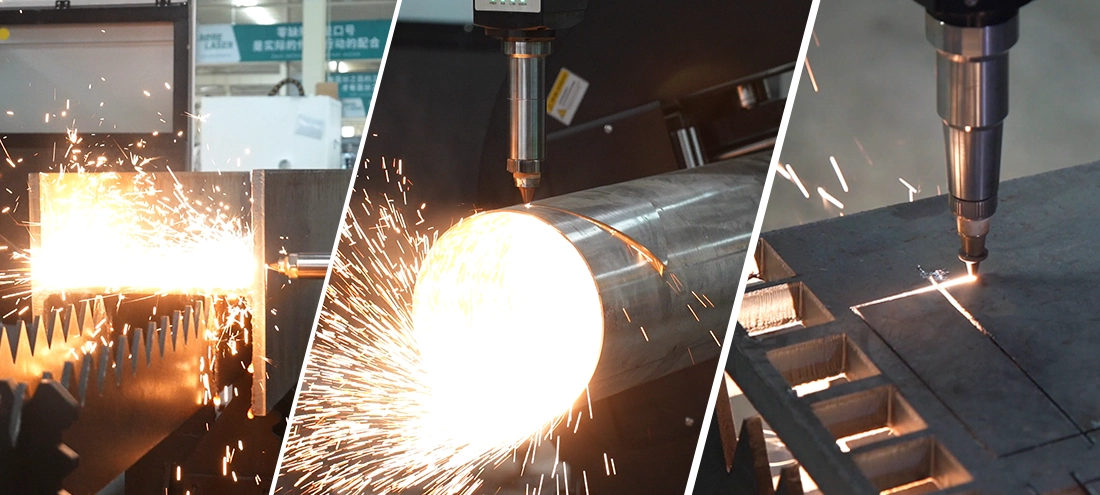
3. Profile Laser Cutting Machine vs. Tube Laser Cutting Machine: Which Is Better?
A common question when purchasing equipment is whether a conventional tube laser cutting machine can replace a profile laser cutting machine.
The answer depends on the types of profiles you process, workpiece dimensions, and the operations you need to complete.
Comparison | Profile Laser Cutting Machine | Tube Laser Cutting Machine |
Main Applications | Structural steel profiles and beam components | Round, square, and rectangular tubes |
Typical Workpieces | H-beams, I-beams, channel steel, and angle steel, depending on configuration | Tubular workpieces within the machine's processing range |
Main Operations | Web and flange hole cutting, beveling, weld access holes, and profile cutoff | Tube cutting, hole cutting, slot cutting, and intersecting-line cutting |
Key Selection Factors | Profile section, length, weight, support method, and required operations | Tube dimensions, chuck capacity, workpiece length, and loading method |
Best Suited for | Steel fabrication involving different profiles and multiple secondary-processing operations | Production focused on batch processing of standard tubes |
Which Machine Is Better for Structural Steel Fabrication?
Neither machine is automatically better for every application. The right choice depends on the workpieces your factory processes and the operations required.
If production mainly involves standard round, square, or rectangular tubes, a tube laser cutting machine may be more suitable.
If you frequently process large H-beams, I-beams, channel steel, and angle steel and need operations such as web hole cutting, flange hole cutting, beveling, or notching, you should evaluate equipment specifically designed for structural profiles.
Can a Tube Laser Cutting Machine Process H-Beams?
You should not assume that every tube laser cutting machine can process H-beams.
The ability to process a particular profile depends on the clamping structure, fixture dimensions, workpiece load capacity, support method, and available processing functions. Large H-beams and I-beams may require a solution designed specifically for structural profiles.
Before purchasing, provide the supplier with your actual workpiece drawings and confirm that the machine can complete the required operations within its specified processing range.
4. How Do You Choose the Right Steel Structure Laser Cutting Machine?
Machine selection should not be based only on laser power or the maximum cutting speed advertised. It should reflect your actual production requirements.
Step 1: Identify Your Main Workpieces
Start by listing the parts your factory processes most frequently, including H-beams, I-beams, channel steel, angle steel, plates, and tubes.
Record the material, cross-section dimensions, length, weight, and cutting features required for each workpiece type.
This information helps you determine whether you need a dedicated profile cutting machine, a tube laser cutting machine, or an integrated processing solution.
Step 2: Define the Required Processing Operations
Review your engineering drawings and list the operations required for each part.
Common operations include profile cutoff, web hole cutting, flange hole cutting, web Z-shaped cutting, flange bevel cutting, weld access hole cutting, notching, and marking.
Ask the supplier to confirm that the specific machine model and cutting system support these functions. A processing demonstration based on your own engineering drawings is more useful than relying only on general product descriptions.
Step 3: Confirm the Processing Range and Load Capacity
The processing range determines whether a machine can accommodate your largest, heaviest, or most complex workpieces.
Check the maximum profile section, workpiece length, plate dimensions, tube dimensions, and permitted load. Also consider how long profiles are loaded, supported, positioned, and unloaded.
These factors are especially important for factories that process long profiles and heavy structural components.
Step 4: Choose Laser Power Based on Your Actual Requirements
The appropriate laser power depends on the material, material thickness, cutting requirements, target processing time, and production volume. Higher power is not necessarily more economical for every factory.
Test the materials and thicknesses you process most often. Compare cutting quality, processing time, and finished-part results under similar conditions before deciding on the power configuration.
Step 5: Evaluate Positioning and Correction Functions
Structural profiles may have positioning deviations or deformation, which can affect processing results.
Find out how the machine identifies the workpiece position, performs centering, and corrects deviations. Confirm the correction range and validate the results using actual profiles.
If hole-position accuracy and component fit are important, check the finished hole positions, cutting profiles, and assembly fit against the tolerances specified in your engineering drawings.
Step 6: Select the Appropriate Cutting System
Different cutting-system configurations may support different combinations of operations, such as profile processing, straight plate cutting, bevel plate cutting, and tube processing.
Before purchasing, confirm that the selected system supports all the processing operations your factory requires.
Step 7: Compare Total Production Costs
The machine purchase price is only one part of the investment. Also consider labor, material handling, floor space, consumables, maintenance, training, downtime, and machine utilization.
If your factory currently uses several separate machines, compare the cost of the complete existing workflow with the proposed integrated solution.
The most economical choice is the machine that meets your production needs at a reasonable total cost, not necessarily the model with the lowest purchase price or the highest advertised power.
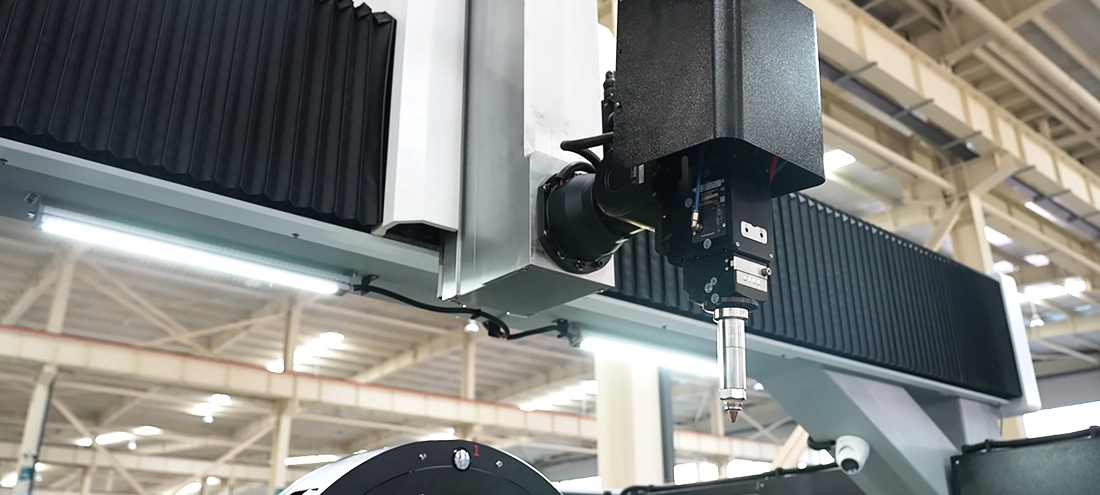
5. What Is the AORE GR-H All-in-One Laser Cutting Machine?
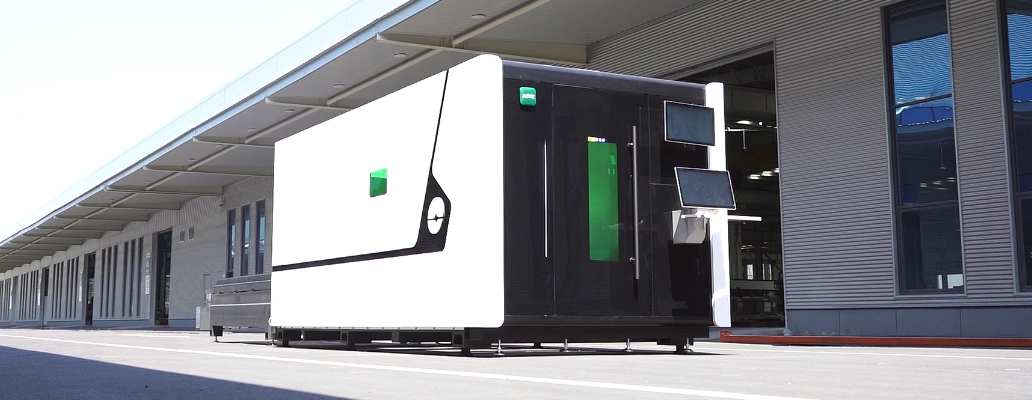
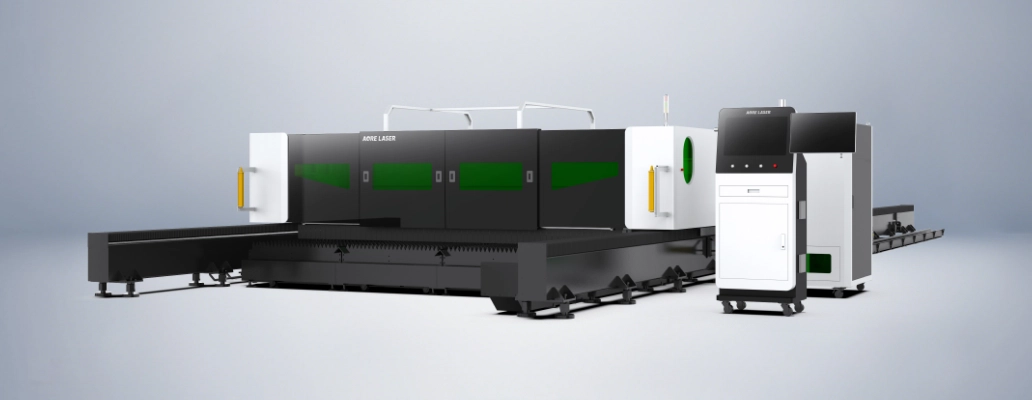
The AORE GR-H Series all-in-one laser cutting machine is designed for manufacturers that need to process profiles, plates, and tubes.
According to AORE GR-H product training materials, the machine is designed to support structural steel processing tasks that might otherwise require several separate machines, using an integrated platform.
5.1 Supports Multiple Structural Steel Processing Operations
The GR-H brings common processing operations together on one platform, helping reduce transfers between separate profile cutting, drilling, and beveling machines.
The specific functions available should be confirmed for the final machine model and cutting-system configuration.
5.2 Integrates Profile, Plate, and Tube Processing
Depending on the selected fixtures and system configuration, the GR-H can process different types of workpieces, including profiles, steel plates, and tubes.
Workpieces listed in AORE’s product materials include plates, H-beams, I-beams, channel steel, angle steel, variable-section beams, crane beams, bulb flats, round tubes, square tubes, rectangular tubes, and end caps.
When evaluating the machine, confirm the applicable processing dimensions, positioning method, and available functions for the workpieces your factory handles most often.
5.3 Intelligent Centering and Correction
Workpiece positioning affects hole locations and cutting profiles, especially when processing large structural sections.
The GR-H structural steel laser cutting machine features one-button centering and intelligent correction functions to help identify workpiece positioning deviations and adjust the cutting path as needed.
For components with demanding processing requirements, ask the supplier to demonstrate the machine using representative workpieces and verify the results against your dimensional requirements.
5.4 High Precision and Industrial-Level Stability
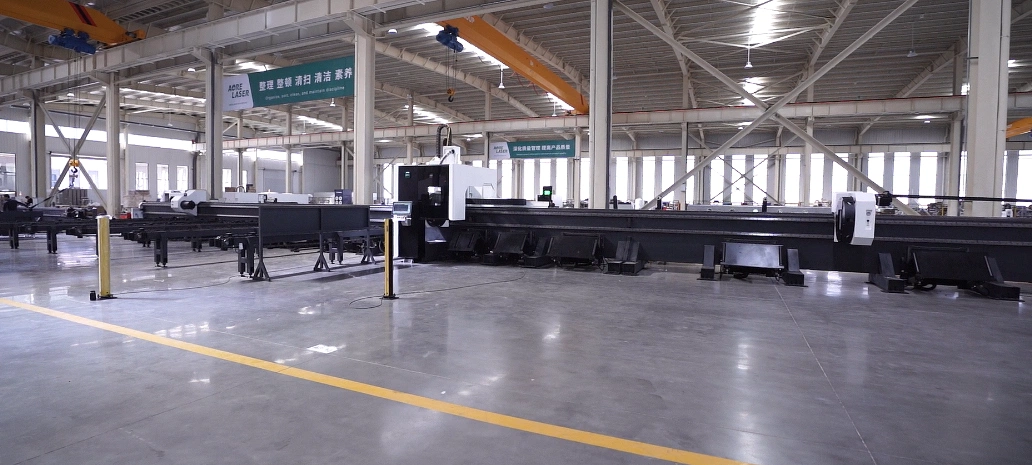
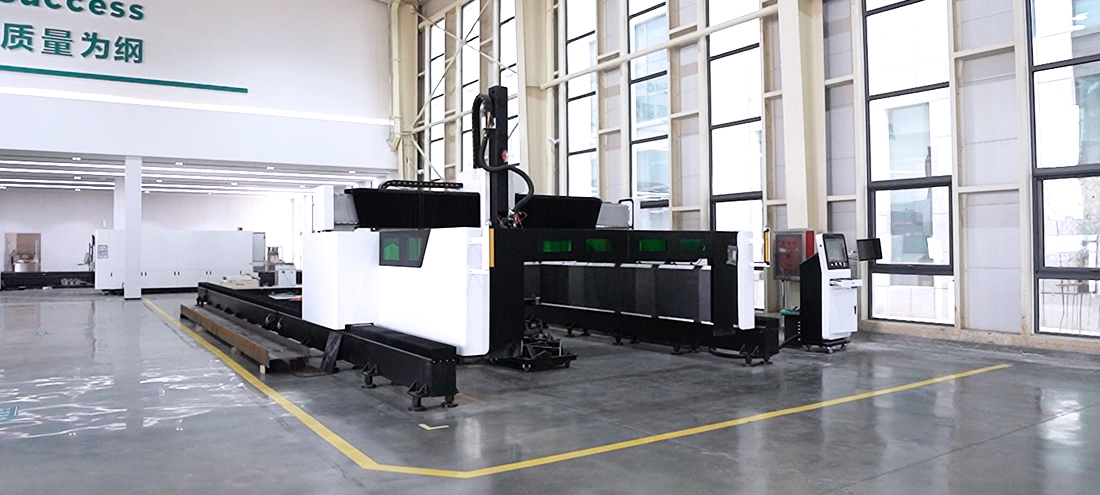
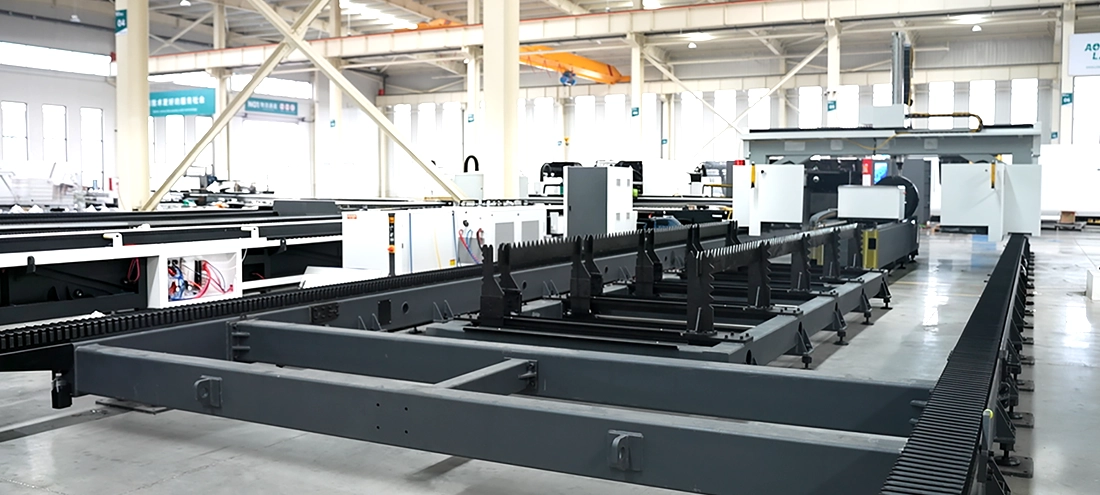
The upgraded bed and guide-rail structure is designed to provide strong structural rigidity. Combined with engineered workpiece support and comprehensive laser protection, the machine is designed to support efficient, precise, and stable operation under demanding working conditions.
When comparing machines, look beyond the advertised cutting speed. Also evaluate the mechanical structure, workpiece support, positioning process, and after-sales service.
If your factory mainly processes standard tubes in high volumes or focuses on large-scale flat-sheet cutting, a dedicated machine may still be the more suitable choice.
Learn more about the AORE GR-H Series all-in-one laser cutting machine and evaluate a configuration based on your factory’s production requirements.
6. Can One Machine Replace Multiple Traditional Secondary-Processing Machines?
This is an important question for steel structure manufacturers planning to upgrade their traditional equipment.
The answer depends on the specific operations to be integrated and the actual capabilities of the selected machine.
Processing Requirement | Traditional Processing Method | AORE Solution |
Profile Cutoff | A separate cutting machine | GR-H All-in-one Laser Cutting Machine |
Web and Flange Hole Cutting | A drilling machine or other separate equipment | |
Beveling | A separate beveling machine | |
Weld Access Holes | Dedicated equipment or manual processing | |
Marking | Separate marking equipment or manual marking | |
Web Z-shaped Cutting | A flame-cutting machine |
The potential advantages of the GR-H include fewer intermediate transfers, better coordination across multiple operations, and a simplified production workflow.
However, an integrated laser cutting machine does not automatically eliminate the need for all separate equipment. The actual result depends on part geometry, processing requirements, production volume, and machine configuration.
Conclusion: Choose the Right Laser Cutting Solution for Your Steel Fabrication Workshop
Choosing a steel structure laser cutting machine should involve more than comparing laser power, maximum speed, or purchase price.
First identify your workpieces and required operations, determine which processes can be integrated, verify the supported processing range, and compare the proposed solution with your existing production workflow.
For manufacturers that process H-beams, I-beams, channel steel, angle steel, plates, and tubes, the AORE GR-H Series offers an integrated processing solution worth evaluating.
Want to find out whether the GR-H all-in-one laser cutting machine is suitable for your factory? Explore the AORE GR-H Series and share your engineering drawings, workpiece dimensions, and processing requirements with AORE to discuss a suitable configuration.
Frequently Asked Questions
1. What machine should I choose for cutting H-beams and I-beams?
The answer depends on the profile dimensions and required operations. If a workpiece needs more than cutoff, such as web hole cutting, flange hole cutting, notching, or beveling, a dedicated structural profile laser cutting machine may be worth considering.
2. Can a tube laser cutting machine process H-beams?
Not every tube laser cutting machine can process H-beams. Before purchasing, check the supported profile dimensions, clamping or support method, workpiece load capacity, and required processing operations.
3. What is the difference between a profile laser cutting machine and a tube laser cutting machine?
A profile laser cutting machine is designed for structural profiles and related processing requirements. A tube laser cutting machine generally focuses on round, square, and rectangular tubes within its processing range. The right choice depends on workpiece shape, dimensions, and required features.
4. What laser power do I need for structural steel processing?
The appropriate power depends on the material, thickness, cutting-quality requirements, production volume, and target cycle time. Test representative workpieces before deciding on the power configuration.
5. Can one machine process profiles, plates, and tubes?
Some integrated machines support all three workpiece categories, but the available dimensions and functions depend on the machine configuration, fixtures, and cutting system. Confirm the detailed processing range before purchasing.
6. How much does a steel structure laser cutting machine cost?
The price depends on laser power, processing dimensions, mechanical structure, cutting system, fixtures, automation, and installation requirements. To obtain a meaningful quotation, provide workpiece dimensions, drawings, material specifications, and required operations.
7. What should I prepare before purchasing a steel structure laser cutting machine?
Prepare your main workpiece types and dimensions, material thicknesses, required operations, expected production volume, and current workflow. Also compare processing capabilities, configuration, operating costs, maintenance requirements, and after-sales service.